
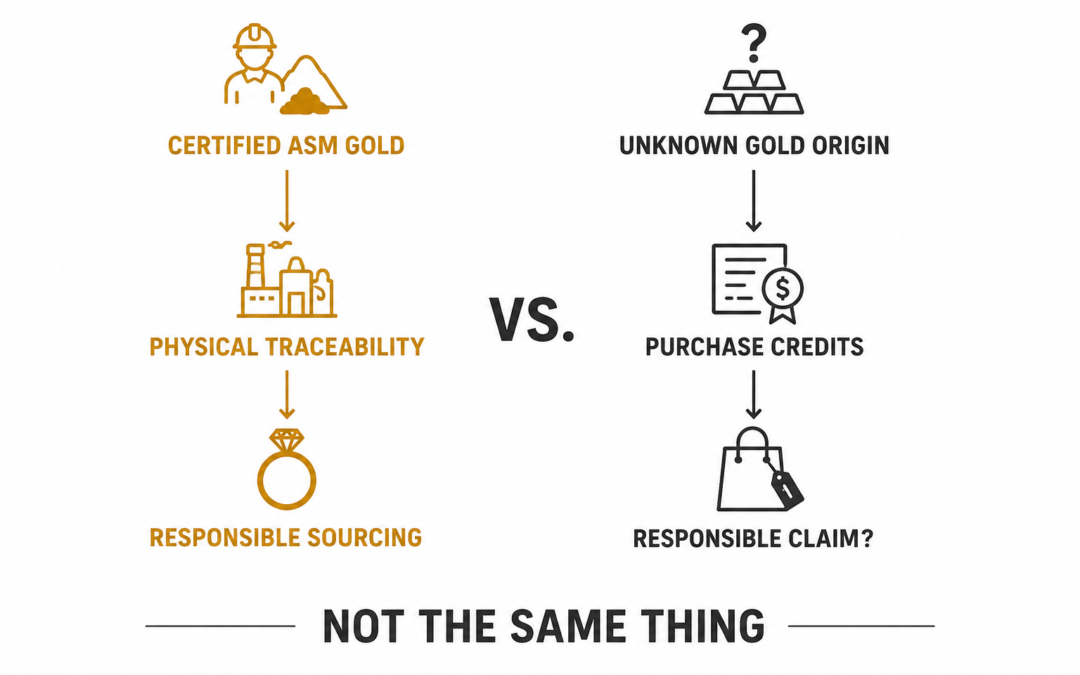
ASM Credits, far from representing a practical solution to promote certified Artisanal and Small-Scale Mining (ASM), risk becoming a mechanism for origin laundering that allows companies to obtain reputational benefits without changing the actual source of the gold they use. This raises serious questions regarding transparency, competition, and the accuracy of claims made to customers, investors, regulators, and other stakeholders.
Among the main concerns are the following:
1. Risk of Origin Laundering
ASM Credits do not change the physical origin of the gold used by a company. However, depending on how they are communicated, they may create the impression that the gold originates from a certified ASM source when, in reality, the metal used may come from non-traceable or unknown supply chains. In practice, this can blur the distinction between using certified ASM gold and merely financing ASM-related initiatives, creating confusion about the true origin of the material being consumed.
2. They Weaken and Put Existing ASM Supply Chains at Risk
Traceable ASM supply chains require years of work and significant investments in sourcing, physical segregation, logistics, auditing, and verification. Overcoming these challenges is precisely what creates their value.
ASM Credits allow companies to make claims of support for ASM without physically incorporating certified ASM material into their supply chains. As a result, credits may become a simpler and less costly substitute that reduces demand for physically traceable ASM gold.
This not only discourages the development of new responsible supply chains but also weakens those that already exist. By allowing companies to obtain similar reputational benefits without assuming the costs and complexities associated with physical traceability, ASM Credits undermine the competitiveness of genuine ASM supply chains and hinder their consolidation and growth in the marketplace.
3. They Do Not Mitigate or Compensate for the Impacts Associated with the Gold Actually Used
While the funds generated through ASM Credits may provide benefits to certain mining communities, this does not mean they mitigate or compensate for the impacts associated with the gold that is actually being consumed.
It is difficult to argue that a relatively small financial contribution can offset risks such as illegal mining, criminal financing, labor abuses, or environmental harm when there is no clear understanding of the composition and origin of the supply chain being used. Financial contributions may create positive impacts, but they do not change the reality of the supply chain that ultimately supplies the product.
4. Real Regulatory and Legal Risks
How ASM Credits are communicated will be critical. Depending on the claims made to customers, investors, regulators, or other stakeholders, companies may face scrutiny related to misleading advertising, unsubstantiated sustainability claims, unfair competition, or statements that create confusion regarding the origin of the material used.
These risks should be assessed in light of the applicable legislation in each jurisdiction and the increasing regulatory scrutiny surrounding sustainability and responsible sourcing claims.
Conclusion
There are currently no shortcuts to adopting certified and traceable ASM gold. The transition may be gradual and partial, but it should be directed toward progressively increasing the share of physically traceable material within the supply chain.
Responsible ASM needs more real supply chains, more traceability, and greater physical integration of certified material into the market. Replacing these efforts with compensation mechanisms may appear to be a convenient solution in the short term, but it risks weakening incentives to develop responsible supply chains, undermining the competitiveness of existing ones, and raising questions about the credibility of the claims being made.
Ultimately, ASM Credits may end up representing an additional cost for companies that adopt them without delivering meaningful benefits in terms of traceability, responsible sourcing, or mitigation of the impacts associated with the gold actually used in their products.
Responsible ASM does not need more compensation mechanisms; it needs greater integration into real supply chains.