
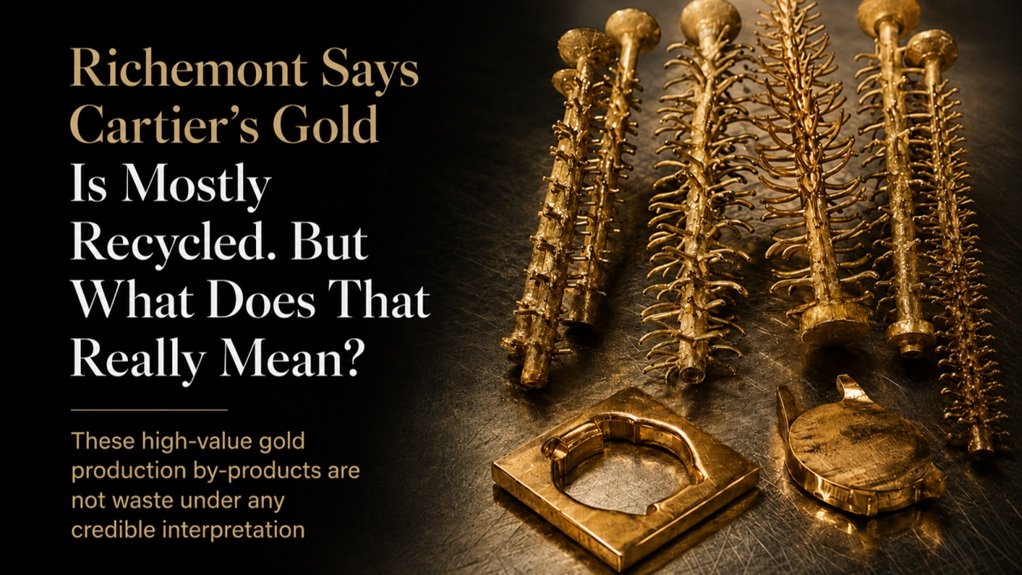
These two statements from Richemont’s 2026 Non-Financial Report confirm an important point: the majority of the gold sourced by Varinor is classified as recycled gold.
“In response to evolving business requirements, Varinor has started purchasing gold from mined sources in FY26. Varinor’s main source of gold remains recycled gold. Varinor’s suppliers are located in the Americas, Asia and Europe. “
“During the reporting period, Varinor purchased the large majority of its gold from both industrial pre-consumer scraps, such as those from watch and jewellery industries, and from post-consumer scraps, including old jewellery. The remaining gold was sourced from other industries, including surface treatment, chemical, pharmaceutical, and electronics. “
However, the use of the word “recycled” deserves closer examination, especially when it is applied to high-grade gold-containing materials that have never entered a waste stream.
A key distinction must be made between pre-consumer scrap and a by-product.
Pre-consumer scrap is material diverted from the waste stream during a manufacturing process.
A by-product is a secondary product generated during the manufacture or processing of another primary product. It has commercial value and is not the main intended output of the process.
This distinction matters because not every material left over from manufacturing should automatically be called recycled. If a gold-containing material has commercial value, is intentionally recovered, and was never discarded or treated as waste, then calling it “recycled” creates a misleading impression.
The Pre-Consumer Gold Problem
When gold watch cases are manufactured, the process often begins with cast or forged blanks of 18-karat or 22-karat gold. These blanks can weigh significantly more than the final finished component. For example, a finished 50-gram 18-karat gold watch case may begin as a 150-gram 18-karat gold blank.
In that example, the 100 grams of gold that does not remain in the final product is not “waste” in any meaningful sense. It is material removed during machining, polishing, cutting, or finishing. Technically, this material is better understood as a by-product of the manufacturing process.
This distinction is critical.
A by-product is not the same as material diverted from a waste stream. Gold shavings, filings, polishing residues, and unused portions of blanks retain extremely high economic value. They are easily collected, returned to a refinery, and reprocessed. In fact, the cost of refining this type of clean, high-value industrial gold material can be very low compared with the value of the gold itself.
At today’s gold prices, the 100 grams of 18-karat gold removed during manufacturing could be worth around USD 10,000, while the 50 grams of gold in the finished product could be worth around USD 5,000. When watch manufacturers produce hundreds of thousands of these blanks in a single month, the so-called “scrap” represents a massive, predictable, and highly valuable industrial by-product, not waste.
This is where the problem begins.
By labeling this material as “pre-consumer recycled gold,” companies create the false impression that they are recovering waste. In reality, this material was never waste. It is a valuable production by-product that was always expected to be collected, recovered, and refined.
The economic incentive is clear. Once this gold is labeled as waste or recycled material, its prior origin effectively disappears. Its carbon footprint is artificially reduced or neutralized, and its new origin point for traceability purposes becomes the refinery rather than the mine.
This means that gold mined only weeks earlier could enter a watch manufacturing process, be removed as shavings or unused blank material, sent to a refinery, and then reappear in the market as “recycled gold” with a new origin point and a much lower claimed carbon footprint.
That is not meaningful circularity. It is a relabeling strategy that converts valuable production by-product into a misleading environmental and traceability claim.
The core issue is not whether the gold is physically reprocessed. The issue is whether valuable manufacturing by-products are being misclassified as waste in order to create environmental and traceability claims that do not reflect the true origin of the material.
A similar issue exists in jewelry manufacturing. When gold jewelry is cast and finished, a significant percentage of the original gold input does not remain in the final piece. In many cases, around 30% of the gold can become manufacturing by-product.
For example, when 18-karat gold jewelry is produced, the finished piece remains 18-karat gold, and the material removed during casting, cutting, polishing, or CNC finishing also remains 18-karat gold. This material may include sprues, excess casting material, filings, shavings, and polishing residues.
These materials are not waste in any meaningful economic sense. They retain very high commercial value and are routinely collected, sold, and sent back to refineries. Once purchased by a refiner, this type of by-product is extremely easy and cost-effective to reprocess.
Therefore, calling this material “recycled gold” can be misleading if the material was never truly waste and was always expected to be recovered as part of the manufacturing process.
The Post-Consumer Gold Problem
A similar problem exists with so-called post-consumer recycled gold.
Used or broken gold jewellery is not normally thrown away like ordinary waste. Gold has too much economic value. Even small pieces are stored, repaired, resold, exchanged, melted, or sold to cash-for-gold shops, pawn shops, jewellers, aggregators, or refineries.
This matters because, for a material to be credibly called recycled, it should first be part of a waste stream or be diverted from disposal. If an object was never realistically destined to become waste, then the term “recycled” becomes questionable.
One gram of gold is worth around USD 146 at today’s prices. Many jewellery pieces contain between 2 and 15 grams of gold. That means even a small broken piece of jewellery can represent hundreds or thousands of dollars in recoverable value. Under these conditions, it is difficult to argue that this gold was truly “waste.”
The problem is not that old jewellery is being refined again. Reprocessing old gold is technically possible and economically rational. The problem is the claim attached to it.
When refineries classify valuable used jewellery as “recycled gold,” they create two misleading advantages. First, the previous carbon footprint of the gold is artificially erased. Second, the origin point for due diligence and traceability is reset at the refinery, cutting off any meaningful link to the original mine or supply chain.
This creates a serious loophole. Gold that may have been mined recently, passed through opaque intermediaries, or entered the market through high-risk channels can be reintroduced as “recycled” simply because it was previously owned or processed.
Calling this material “recycled” does not make it transparent, low-risk, or environmentally neutral. Without proof that the material was truly diverted from a waste stream, “recycled gold” becomes a convenient marketing label used to disguise untraceable gold as a sustainability claim.
The RJC Chain of Custody Illusion
Richemont also states:
“The Group requires certification under the RJC Code of Practices (CoP) and RJC Chain of Custody (CoC) across relevant supply chains. The RJC is a recognised standard-setting organisation for the watch and jewellery industry and its supply chains, from mining to retail. RJC CoP certification requires members to comply with a range of criteria, relating to responsible business practices, due diligence for responsible sourcing, human rights, labour rights, environmental impact and product disclosure. RJC CoC certification focuses on the responsible production, processing and trading of gold, silver and platinum group metals. It aims to ensure traceability and responsible sourcing, whether from mined or recycled origins, through chain of custody maintained across the value chain. Both RJC CoP and CoC certifications require independent third-party audits to verify compliance with applicable standards. Suppliers in the Group’s coloured gemstones supply chain, which includes rubies, sapphires and emeralds, are also encouraged to obtain RJC CoP certification. Richemont may also recognise equivalent standards, provided they adhere to comparable principles and due diligence procedures. “
This statement creates the impression that RJC Chain of Custody certification provides meaningful traceability across the full gold supply chain. However, in the case of recycled gold, this can be misleading.
The problem is that the RJC Chain of Custody system generally covers the certified companies inside the chain, such as refiners, manufacturers, and other audited entities. But the highest-risk parts of the recycled gold supply chain are often outside the audited scope. These include gold aggregators, pawn shops, cash-for-gold establishments, jewellery buyers, and the informal or semi-formal networks that supply them.
In other words, the refinery may be certified, and the manufacturer may be certified, but the original point where the gold entered the recycled supply chain may remain completely opaque.
This is especially important for post-consumer gold. Refineries often do not know where the gold was truly sourced at the consumer-facing level. They usually rely on documentation provided by their direct suppliers, which are commonly gold aggregators. Those documents may identify the aggregator, but they do not provide meaningful visibility into the pawn shops, cash-for-gold stores, jewellery buyers, or other upstream sources that originally collected the material.
These points of commerce are not audited in any way. In many sustainability reports, they are not even mentioned. The words “pawn shop” and “cash-for-gold” conveniently disappear, even though these channels are essential to the recycled gold supply chain.
This creates an illusion of traceability. The certified chain begins only after the highest-risk part of the chain has already been excluded.
The issue is not whether gold can be refined again. The issue is whether companies can claim traceability, lower carbon impact, or responsible sourcing while the supposedly recycled gold cannot even be traced back to the pawn shops or cash-for-gold establishments where it originally entered the supply chain.
The Market Is Already Moving Away From the Term
Signet, Brilliant Earth, and some academics have moved away from the term “recycled gold” for this exact reason: much of this material was never truly waste.
Signet spokesperson Katie Spencer tells JCK: “Signet aligned on using repurposed as our terminology and not using recycled, because recycled should really only apply to products intentionally diverted from a waste stream. And gold is rarely if ever part of a waste stream. https://www.jckonline.com/editorial-article/signet-term-recycled-gold/
No one ever throws away their gold. Because it’s not considered a typical waste product, “recycled gold” is only accurate when the gold is reclaimed from e-waste. To reflect this, the jewelry industry updated the definition to “repurposed” in 2024. From here on out, we will refer to our gold and silver as “repurposed.” https://www.brilliantearth.com/about/mission/report-2024/sustainability/
Mario Schmidt, director of the Institute for Industrial Ecology (INEC) at Pforzheim University, says “recycling is defined by the fact that it has been used by the end consumer.” Based in Pforzheim, Germany’s gold-refining hub, Schmidt is a proponent of the environmental gains for melting down old jewellery, but is more cautious when it comes to the so-called ‘pre-consumer’ materials, which includes manufacturing scrap. “Strictly speaking, this is not recycling; only an inefficiency in production.” https://www.vogue.com/article/the-jewellery-industry-loves-recycled-gold-is-that-a-good-thing
One of the largest 18-karat gold jewelry retailers in the world has stopped using the term “recycled gold,” explicitly recognizing that gold is rarely, if ever, waste. Another publicly listed U.S. company has reached a similar conclusion. Yet many European luxury companies continue to describe high-value gold-containing materials from pre-consumer and post-consumer sources as “waste.”
Changing terminology at a corporate level is not easy. But the teams advising these companies to keep using such a weak and damaging interpretation are responsible for the claims being made and should be held accountable.
Luxury companies have some of the highest margins in the market. They can afford better traceability. They can afford to address carbon impacts more honestly. And they can afford to stop relying on terminology that creates a misleading impression of environmental benefit.
These companies appear to be poorly advised. Signet and Brilliant Earth already corrected their language by moving away from “recycled” and adopting more accurate terminology such as “repurposed.” They did not face negative consequences. On the contrary, the market benefited from greater honesty and clearer disclosure.
For the sake of transparency, companies should also disclose that full origin traceability is not possible under the current RJC Chain of Custody system when the riskiest upstream actors fall outside the audited scope. The certified entities may be audited, but the pawn shops, cash-for-gold establishments, aggregators, and other opaque sources that feed the post-consumer gold market are often not.
It would be far more honest to clearly disclose that much of so-called post-consumer recycled gold is sourced through pawn shops, cash-for-gold businesses, and gold aggregators around the world, rather than allowing consumers to believe that this material is fully traceable, low-risk, or truly diverted from waste.
Conclusion
The issue is not whether gold can be refined again. It can. The issue is whether the word “recycled” is being used to create environmental and traceability claims that the supply chain cannot support.
Gold manufacturing by-products are not automatically waste. Used gold jewellery is rarely waste. And RJC Chain of Custody certification does not, by itself, prove full origin traceability when the riskiest upstream actors are outside the audited scope.
If luxury companies want to make credible sustainability claims, they should use more accurate language, disclose the limits of traceability, and stop presenting high-value gold-containing material as if it were ordinary waste rescued from disposal.
The gold industry does not need more creative terminology. It needs more honesty.